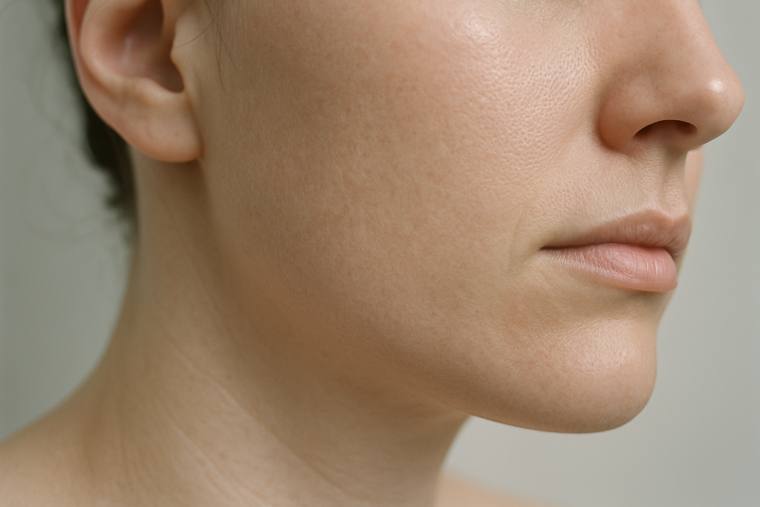
How Endolift works
Endolift belongs to a small category of treatments that sit between topical devices and surgery. Rather than delivering energy through the skin surface, a fibre roughly the width of a human hair is introduced under the skin through an entry point that requires no incision and no stitches. That fibre carries 1470nm laser energy directly into the subdermal fat and fibrous septae.
The 1470nm wavelength matters. It is strongly absorbed by both water and fat, which means the energy is deposited exactly where the operator places it rather than scattering through the dermis. The effect is twofold: a small volume of fat is reduced, and the fibrous network supporting the skin contracts and subsequently remodels.
That second effect is the slow one, and it is the one patients are really buying. Immediate tightening from thermal contraction is modest. The meaningful change comes from neocollagenesis over the following months, the same biological process that underlies most energy-based skin treatments.
What the published evidence shows
The literature on Endolift specifically is limited but not absent, and it is more encouraging than for many treatments marketed with far greater confidence.
Published case series report measurable improvement in skin laxity scores in the majority of treated patients, with the strongest effects in the submental area and lower face. Ultrasound imaging in several studies shows increased dermal thickness at three and six months post-treatment, which is a more objective endpoint than photographic assessment alone.
The realistic caveats matter as much as the findings:
- Sample sizes are small, typically twenty to sixty patients
- Most studies lack a control group or blinded assessment
- Follow-up rarely extends beyond twelve months, so durability is not well characterised
- Several published series involve the device developers
None of that makes the treatment ineffective. It means the confidence interval around any claim is wider than marketing suggests. A patient told "clinically proven" should understand that in aesthetics this phrase carries far less weight than it does in pharmaceutical medicine, where the regulatory bar set by bodies such as NICE is considerably higher.
Where it works best
Anatomical selection determines outcomes more than operator technique, which is unusual for a device treatment.
| Area | Suitability | Notes |
|---|---|---|
| Submental, under the chin | Strong | The best-documented indication. Combines fat reduction with tightening. |
| Jawline | Strong | Good for early jowling where skin quality remains reasonable. |
| Nasolabial and lower cheek | Moderate | Helps mild laxity, will not replace volume. |
| Upper arms, inner thigh | Moderate | Larger surface area, more sessions, more variable results. |
| Periorbital | Limited | Skin is thin. Risk profile changes considerably. |
The single biggest predictor of a disappointing Endolift result is treating a patient who needed surgery.
Patients with significant skin redundancy, established platysmal banding, or heavy submental fat with poor skin elasticity are surgical candidates. A practitioner who takes their money for a device treatment instead has done them a disservice, however skilfully the treatment is delivered.
Realistic results and timeline
- Week one. Swelling and firmness. Some patients look worse before better. Bruising is common.
- Weeks two to four. Swelling settles. Early tightening becomes visible.
- Months two to four. Collagen remodelling produces the majority of the visible change.
- Month six. Final result. This is the correct point for before and after comparison.
Anyone judging the outcome at four weeks is judging it too early, and any clinic photographing final results at four weeks is photographing swelling.
Risks and recovery
Because the fibre passes beneath the skin, the risk profile differs from surface devices. Reported complications include prolonged swelling, bruising, transient numbness, palpable firmness or nodularity along the treated plane, and, uncommonly, contour irregularity where energy delivery was uneven.
Burns and skin necrosis have been reported where energy was delivered too superficially. This is an operator-dependent risk, which is the strongest argument for treating practitioner selection as the main decision. Verify any UK practitioner on the GMC register or through Save Face, and ask directly how many Endolift procedures they have personally performed.
Most patients return to normal activity within two to three days, with visible swelling for up to two weeks.
Cost in the UK
Observed UK pricing in 2026 runs from roughly £1,200 for a single small area such as the submental region, to £2,500 or more for the full lower face and neck. Some clinics price per area, others per session with multiple areas included, which makes direct comparison difficult.
Prices below £800 for the lower face are worth questioning. Either the protocol is abbreviated, the energy delivered is minimal, or the device is not what is being described.
How it compares
| Treatment | Mechanism | Downtime | Realistic effect |
|---|---|---|---|
| Endolift | Subdermal 1470nm laser | 2 to 5 days | Moderate tightening, some fat reduction |
| Focused ultrasound | Transcutaneous thermal coagulation | None | Mild to moderate tightening |
| Radiofrequency microneedling | Fractional dermal heating | 2 to 4 days | Texture and mild tightening |
| Thread lift | Mechanical repositioning | 3 to 7 days | Immediate lift, limited duration |
| Surgical lower facelift | Tissue excision and repositioning | 2 to 3 weeks | Definitive |
Endolift's genuine niche is the patient who is too advanced for surface devices and not ready for surgery. That is a real and reasonably large group, and it explains the treatment's growth. It is also a narrow enough window that a good practitioner will tell a meaningful number of enquirers that they fall outside it.